


Why Motor Oil Is Not the Best Choice for Clock Movements

For years, hobbyists and clock owners have debated whether synthetic motor oil — particularly 5W-20 automotive oil — can be safely used in mechanical clocks. Some people claim it works well. Others strongly disagree.
The truth is more nuanced.
Modern synthetic motor oils are vastly superior to many older oils once commonly found around the home and workshop. Compared to household oils, spray lubricants, or untreated general-purpose oils, synthetic engine oil may appear to perform reasonably well in the short term.
But clock movements are not automobile engines.
And that difference matters far more than many people realize.
After years of servicing and maintaining mechanical clocks, one thing becomes very clear: clocks require lubrication behavior that is very different from what automotive oils were designed to provide.

Why Some People Started Using Synthetic Motor Oil in Clocks
The popularity of synthetic motor oil in clock discussions did not appear out of nowhere.
There is a reason many hobbyists began experimenting with oils like 5W-20 synthetic motor oil years ago.
Modern engine oils are:
highly refined
resistant to breakdown
widely available
relatively stable compared to older household oils
inexpensive compared to specialty clock oils
Some clock owners used small amounts successfully and shared their experiences online. Over time, those recommendations spread through forums, blogs, and repair discussions.
And to be fair, many clocks will continue running after being lubricated with motor oil — at least for a while.
That short-term success is what often convinces people it is the “best” solution.
But long-term clock lubrication is a very different subject than simply getting a clock running.
A Clock Movement Is Not an Engine
This is the single most important point to understand.
Automobile engines operate under:
high temperatures
high pressures
rapid movement
constant oil circulation
filtration systems
sealed environments
Mechanical clock movements operate under almost the exact opposite conditions.
Clock pivots rotate extremely slowly under very light loads. There are no oil pumps, no filters, and no pressurized lubrication systems. Instead, clocks rely on tiny amounts of carefully placed oil remaining stable at microscopic pivot points for years at a time.
Modern synthetic motor oils were designed for high-temperature, high-pressure automotive environments — not the extremely low-load, slow-moving pivots found inside mechanical clock movements.
That distinction is critical.
The Additives Inside Motor Oil
Most automotive oils contain complex additive packages specifically engineered for engines.
These additives may include:
detergents
dispersal
anti-wear compounds
viscosity modifiers
corrosion inhibitors
contaminant suspension agents
Inside an engine, those additives serve an important purpose. Engines create combustion byproducts, carbon contamination, moisture, heat, and metal particles that must be managed continuously.
Mechanical clocks do not operate in those conditions.
Clock movements require stable, controlled lubrication behavior with minimal spreading, minimal residue formation, and long-term consistency at extremely fine pivot surfaces.
Oil Migration Inside Mechanical Clock Movements
One of the biggest differences between automotive lubrication and clock lubrication is oil migration.
In a clock movement, oil must stay exactly where it is applied.
Excess spreading can allow oil to:
move away from pivots
contaminate nearby plates
attract dust and debris
form abrasive residue over time
Clock pivots operate with extremely small clearances. Even slight contamination or improper lubrication behavior can gradually increase wear over the years.
This type of wear often develops slowly and silently. A clock may continue running long after damage has already begun inside the movement.
That is why experienced clock repair professionals tend to focus heavily on long-term lubrication behavior rather than short-term operation.
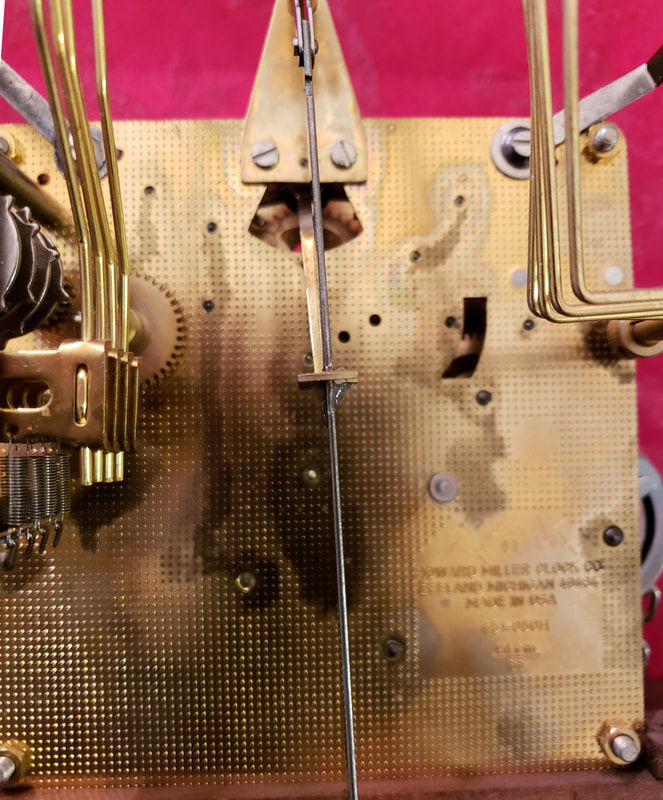
How Harsh Oils Can Damage Brass Clock Movement Plates
Many brass clock plates are protected by a thin lacquer coating designed to help preserve appearance and reduce tarnishing over time.
In some cases, harsh or improperly chosen lubricants may soften or break down this lacquer coating. As oil spreads across the movement plate, dissolved lacquer and contamination can slowly migrate toward pivot holes and bushings.
Over time, dust and residue may combine with this material and gradually harden inside critical pivot areas. Eventually, increased friction can interfere with proper operation and may even stop the clock entirely.
The problem often develops slowly over many years and may not become visible until significant contamination has already formed inside the movement.
In many older clock movements we serviced, the visible problem was not simply old oil — but hardened contamination caused by years of improper lubrication and oil migration.

“But My Clock Runs Fine on Motor Oil”
This is probably the most common response in lubrication discussions.
And honestly, many clocks will continue running with motor oil for a period of time.
But running is not the same thing as proper long-term lubrication.
A mechanical clock can often continue operating while:
pivot holes are wearing
oil is spreading improperly
residue is building
friction is slowly increasing
In many grandfather clocks, the actual damage develops gradually over years rather than days or weeks.
By the time performance problems become obvious, wear may already exist inside the movement.
That long-term perspective is one of the biggest differences between casual lubrication advice and professional clock servicing.
Why Purpose-Made Clock Oils Exist
Clock oils were developed specifically for the unique operating conditions found inside mechanical clock movements.
A proper clock oil is designed to provide:
stable viscosity
controlled flow behavior
low migration
long-term lubrication stability
resistance to gumming
protection for delicate brass pivot systems
This becomes especially important in larger grandfather clocks that may operate continuously year after year.
Proper lubrication is not simply about making a clock run today.
It is about reducing unnecessary wear over the long term while preserving the movement itself.
Final Thoughts
Synthetic motor oils are excellent products when used for the purpose they were designed for — protecting modern automobile engines.
Mechanical clocks are a completely different type of machine.
While some hobbyists may report acceptable short-term results using 5W-20 motor oil in clocks, purpose-made clock oil remains the better choice for long-term lubrication performance, reduced wear, and proper behavior inside precision clock movements.
When maintaining a mechanical clock, the goal should never be simply keeping it running temporarily.
The goal should be protecting the movement for the next generation.


Comments