


The Difference Proper Oil Makes

Updated: May 18
Why the Right Clock Oil Matters More Than Most People Realize
A mechanical clock is a machine built on precision. Tiny pivots rotate inside even tinier bushings, often for years at a time, carrying the weight of gears, springs, and time itself. Yet one of the biggest mistakes made by clock owners—and even inexperienced repairers—is assuming that “oil is oil.”

It is not.
The difference proper clock oil makes can determine whether a clock runs beautifully for decades or slowly destroys itself from the inside out.
A Clock Runs on Friction Control
Every moving part inside a mechanical clock creates friction. Without lubrication, steel pivots grind against brass bushings. Wear begins immediately, even if it cannot yet be seen.
A proper clock oil creates a microscopic protective barrier between those surfaces. That barrier reduces friction, slows wear, and allows the movement to operate efficiently with less strain.
When the wrong oil is used, or when old oil breaks down, several things begin happening:
Increased friction
Loss of power through the gear train
Premature wear on pivots and bushings
Poor timekeeping
Excessive dirt buildup
Eventual movement damage
Most clocks do not suddenly fail overnight. They slowly wear themselves out because lubrication was neglected or incorrect.
The Hidden Damage of the Wrong Oil
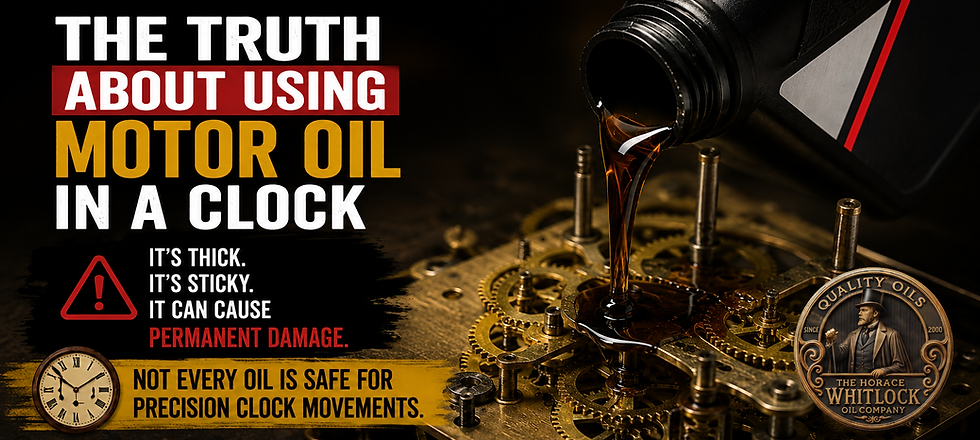
One of the most common problems seen in older clocks is thick, sticky oil residue. Over time, poor-quality oils oxidize and turn into a gummy varnish-like substance. Dust mixes into the old oil and creates an abrasive paste that accelerates wear.
This is especially common when people use household oils such as:
3-in-1 oil
WD-40
Motor oil
Sewing machine oil
Gun oil
General-purpose lubricants
These products may seem fine at first. In fact, many clocks temporarily run better right after application because fresh liquid loosens old residue. But the long-term results are often destructive.
A clock movement requires oil specifically designed for:
Extremely low-load precision pivots
Long-term stability
Resistance to gumming
Controlled viscosity
Minimal spreading or migration
Most general-purpose oils were never engineered for these conditions.
What Proper Clock Oil Actually Does
A true clock oil is formulated to remain stable for long periods while maintaining the proper lubricating film between moving parts.
When proper oil is used, several improvements are often noticeable:
Smoother Operation
The gear train moves with less resistance, allowing the movement to use power more efficiently.
Better Timekeeping
Reduced friction helps maintain consistent pendulum amplitude and escapement action.
Reduced Wear
Pivots and bushings last dramatically longer when properly lubricated.
Cleaner Movement
Quality synthetic oils resist breakdown and attract less contamination over time.
Longer Service Life
A properly maintained movement may operate for generations with significantly fewer major repairs.
The oil itself may seem insignificant compared to the size of the clock, but inside the movement it plays a critical role every second the clock runs.
Why Antique and Grandfather Clocks Are Especially Vulnerable
Large mechanical clocks often run continuously for years. Grandfather clocks, wall clocks, and antique mantle clocks place constant stress on pivots and bushings. Once wear begins, repair costs rise quickly.
A worn movement may eventually require:
Bushing work
Pivot polishing
Gear replacement
Complete overhaul
Movement replacement
Many expensive repairs could have been delayed—or avoided entirely—with proper lubrication and maintenance.
Oiling Alone Is Not a Complete Service
This is important to understand.
Applying fresh oil to a dirty movement is not the same as a professional overhaul. If old degraded oil and contamination remain inside the movement, new oil can only do so much.
However, routine maintenance using proper clock oil can still help protect a movement between major services and reduce unnecessary wear.
Think of it like changing oil in an engine. Clean oil cannot reverse existing damage, but proper lubrication helps prevent future damage from accelerating.
The Goal Is Preservation
A mechanical clock is more than decoration. Many are family heirlooms that carry history, craftsmanship, and memories across generations.
Proper clock oil helps preserve:
Accuracy
Mechanical integrity
Longevity
Original components
Overall value
In many cases, the difference between a clock surviving another 50 years—or wearing itself beyond economical repair—comes down to lubrication and maintenance habits.
Final Thoughts
The smallest details inside a clock often matter the most.
The correct oil may seem like a minor decision, but inside a precision mechanical movement it becomes one of the most important factors in long-term performance and preservation.
Good clock oil does not simply make a clock run.
It helps protect the movement from becoming worn out before its time.
And for anyone who truly values mechanical clocks, that difference matters.
Ok so this was just a test and it loo


Comments